Banana Walnut Bread

 Add to favorites
– raw, vegan, gluten-free –
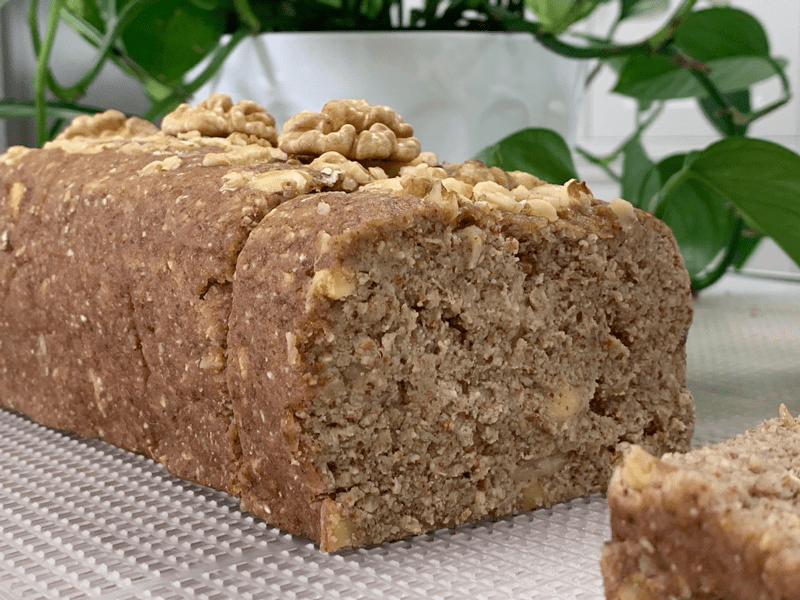
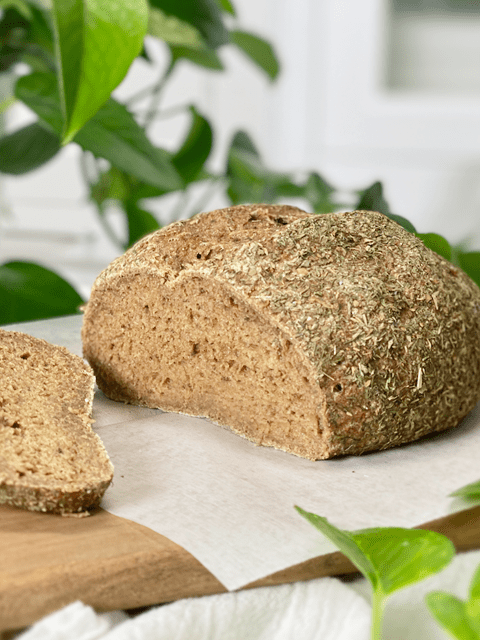
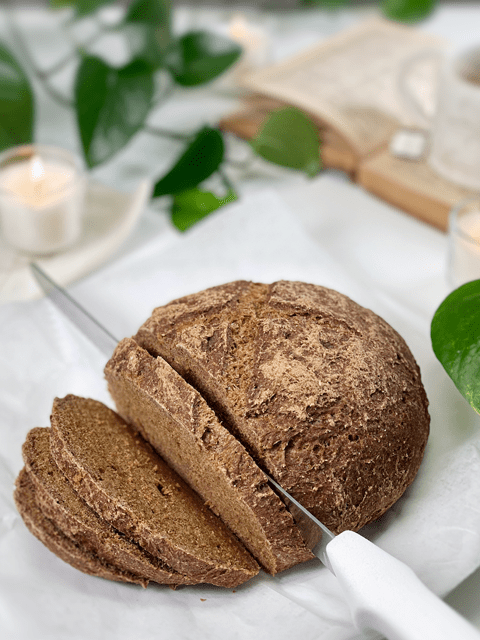
Who doesn’t love banana bread? It’s a moist, sweet, and cake-like bread that smells like heaven. This raw version lives up to that description beautifully! I have made many raw breads, and this combination of ingredients is fantastic. My husband and I found the balance of flavors and texture to be just about perfect.
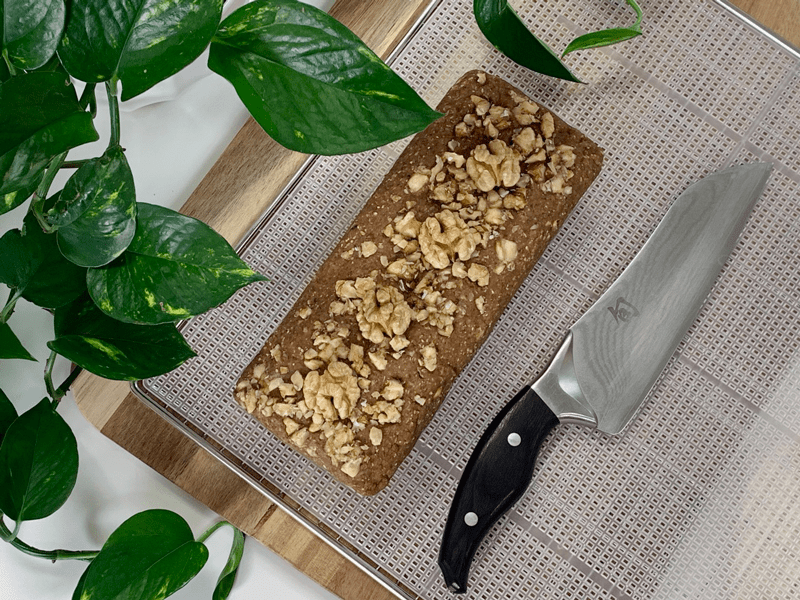
Now, the star of the show here is (you guessed it) bananas. And not just any bananas — ripe bananas. I mean it. The kind that look a little too spotty for polite company but are just right for bold flavor. Don’t skimp here — if your bananas aren’t ripe, your bread will be bland. And nobody has time for bland banana bread. Not sure if it’s sweet enough? Sneak a taste of the dough before shaping and dehydrating. That’s not cheating, it’s quality control.
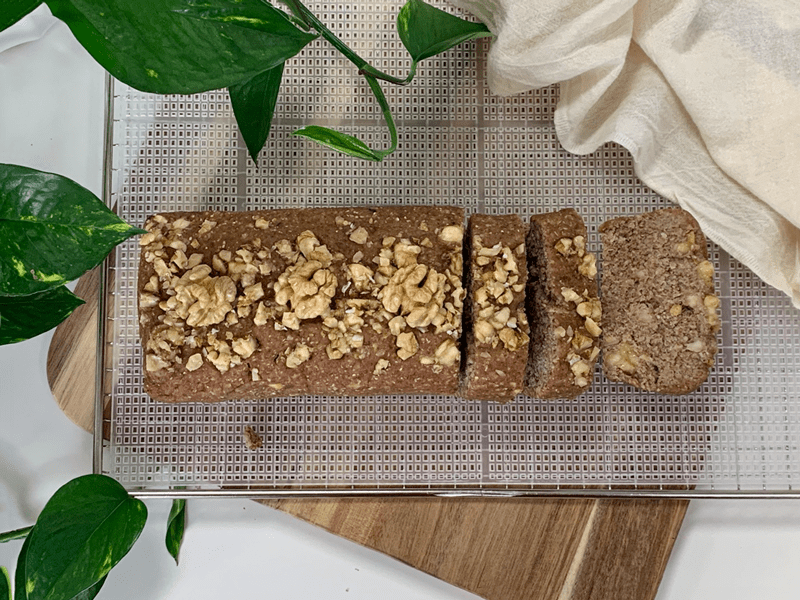
The different sweeteners also serve a second purpose in the recipe, acting as a helpful binding agent. For this bread I used three different sweeteners, and no, it’s not overkill. Each one adds its own personality to the mix.
- Dates bring a rich, mellow sweetness and they help bind everything together.
- Stevia sweetens without altering the texture or adding much flavor.
- Raw honey adds a warm, floral depth — but if you’re bee-gan (a vegan who avoids honey), feel free to swap in maple syrup or another liquid sweetener you love. A quick side note on honey: be sure to use raw, unprocessed honey if you’re going that route — some brands sneak in corn syrup (rude, right?).
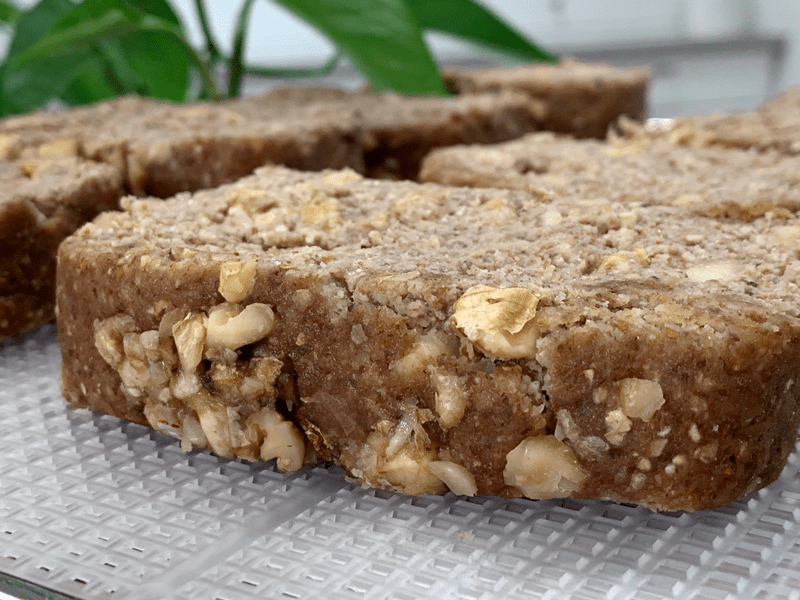
Let’s circle back to those bananas for a sec. Need to ripen them faster? It’s all about ethylene gas. Sounds science-y, but it’s just something bananas (and a few of their produce pals like apples and tomatoes) naturally emit as they ripen. Trap that gas by popping your bananas in a paper bag with an apple or tomato. Voilà — nature’s speed-ripening trick.
Beyond flavor, bananas are basically nature’s multivitamin. They’re packed with vitamins A, B1, B2, B3, B5, B6, B9, C, plus minerals like calcium, iron, magnesium, phosphorus, potassium, and zinc. I mean, I’ll gladly take my supplements in the form of Raw Banana Walnut Bread — wouldn’t you?
And here’s the kicker: this bread is so moist and flavorful, you don’t need to slather anything on it. But if you’re feeling fancy (or just love your partner a lot), try it with my Coconut Date Butter. It’s a perfect match. many blessings, amie sue
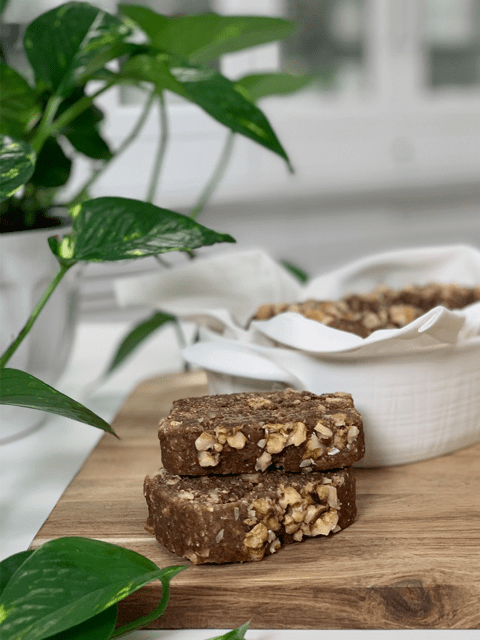 Ingredients:
Dry Ingredients:
Wet Ingredients:
Hand mix in:
- 1 cup (200 g) chopped walnuts, soaked
- 2 Tbsp (16 g) walnuts, chopped for topping
- 1 banana (137 g), diced into chunks (optional)
Preparation:
- In the food processor fitted with the “S” blade, place the following ingredients: oats, flax, coconut flour, cinnamon, and salt. Pulse together until combined. Place the dry ingredients in a small bowl and set aside.
- In the same food processor bowl, combine the almond pulp, banana, date paste, sweetener, vanilla, and lemon juice. Blend till everything is well incorporated.
- Depending on how dry your almond pulp is, you may need to add water, so the dough sticks together nicely.
- If you this, add 1 Tbsp at a time.
- Add the dry ingredients to the wet ingredients, along with the nut pulp in the food processor, and mix everything well.
- Transfer the dough to a cutting board and fold in the walnuts and diced banana. Shape the mixture into a loaf and place it on the mesh sheet that comes with your dehydrator.
- Score the top of the loaf with a knife. I later use these score marks as a guide in slicing my pieces. Sprinkle the 2 Tbsp of crushed walnuts on top and gently press them in a bit.
- Dehydrate at 145 degrees (F) for 1-2 hours. This will create a crust on the outside.
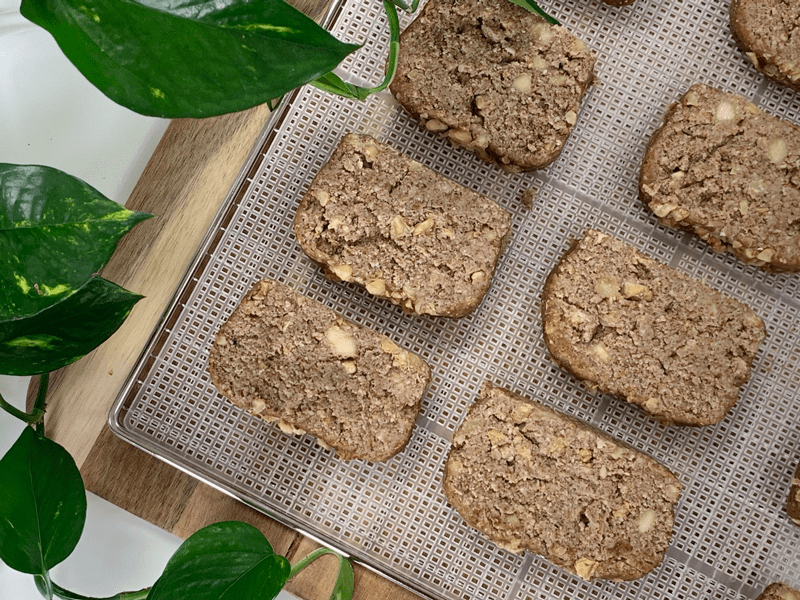
- Remove from the dehydrator, place the loaf on a cutting board, and slice into pieces to the desired thickness. I did mine at about 1″ thick. Return the bread to the mesh sheet, laying the pieces flat.
- Decrease the temperature to 115 degrees (F) and continue to dehydrate for approximately. 6-10 hours.
- As an indicator, if it is dry enough, touch the center of the bread slices.
- You don’t want it to be doughy, but you also don’t want the bread to dry out too much. You decide on how dry you want the end result to be.
- The bread darkens it as it dehydrates.
- Shelf life and storage: My recommendation is to store this bread in an airtight container in the fridge for 3-5 days. The more moisture that is left in your bread, the shorter the shelf life. Therefore, the shelf life will vary depending on your drying technique. Whenever I make this bread, it never lasts very long enough to spoil. Keep in mind, the whole purpose of eating a raw diet is to eat foods at their peak of freshness, so don’t expect this bread to have a long shelf life.
- To warm the bread before eating, place it in the dehydrator set at 145°F for 5-10 minutes.
The Institute of Culinary Ingredients™
- To learn more about maple syrup by clicking (here).
- Raw honey isn’t vegan, but I still use it now and again. Read (here) why I like to.
- Learn about the beautiful characteristics of Raw Coconut Nectar (here).
- Click (here) to learn why I use stevia.
- Why do I specify Ceylon cinnamon? Click (here) to learn why.
- What is Himalayan pink salt, and does it matter? Click (here) to read more about it.
- Are oats gluten-free? Yes, read more about that (here).
- Are oats raw? Yes, they can be found. Click (here) to learn more.
- Do I need to soak and dehydrate oats? Not required but recommended. Click (here) to see why.
- Learn how to grind flaxseeds for ultimate freshness and nutrition. Click (here).
Culinary Explanations:
- Why do I start the dehydrator at 145 degrees (F)? Click (here) to learn the reason behind this.
- When working with fresh ingredients, it is essential to taste test as you build a recipe. Learn why (here).
- Don’t own a dehydrator? Learn how to use your oven (here). I do, however, honestly believe that it is a worthwhile investment. Click (here) to learn what I use.
© AmieSue.com
Tags: Dairy Free, Gluten Free, Nut Free, Refined Sugar Free, Soy Free, sugar free, Vegan



This looks amazing, Amie Sue! Is there any replacement for the almond pulp? I never have almond pulp o hand because I do not get around to making almond milk! What is the purpose of the almond pulp?
THANKS YOU!!!! BLESSINGS!!!
Hello Chris… you can try almond meal but it might be a bit denser. You could try sprouted buckwheat flour…but I encourage you to make some nut milk, any kind and use the pulp in the recipe. You might a new love for a non-dairy drink. :)
I accidentally went to your website, and learned a lot from it. I am tring to be a raw vegan. at least one mont and then we will go from there. But thank you very much for your good receips and teaching adwices. I never see bread receipes before. I am just exploring in the” raw world” Good luck to me :)
Melania
Well Melania, I am glad that you accidentally found my site. If you have any questions, please let me know and i will help as much as I can. amie sue
This is on the menu for next week. Thanks, Amie-Sue.
Keep me posted! Enjoy!
Bravo!
The recipe is excellent with other fruit-nut combos as well. We’ll be eating persimmon-pecan bread next week.
Can an oven be used for dehydration of the Banana nut bread (I think 150 is lowest setting)? Or will this make the bread “baked” vs raw? If it’s ok, how long does the bread need to be inside the oven? Thank you.
Tina… the oven will “cook” it and defeat the aim for retaining the enzymes. amie sue
OMG….I love your website! :)Thank you
lol Valentina… thank you, I am so glad that you do. If I can be of help during your recipe exploration here, just let me know. Have a great evening, amie sue
Made this recipe with very ripe persimmons and pecans instead of banana and walnut. Superb! Thank you.
OH sounds scrumptious! I wonder if they have any ripe ones where I am right now. I might has to try this. Thank you :) amie sue
Looks & tastes like pumpkin bread, with the orange color and the spices. The persimmon season is almost done, so hope you get a few ripe stragglers.
I am going to check tomorrow. :) Sounds delicious! amie sue
Gingerbread that was black with molasses was a mainstay when I was a child. I think I’ve figured out how to make a raw version of that childhood favorite using your recipe here, with a few subsitutions.
I’m trying out my idea this weekend.
Thanks, Amie Sue. You’ve opened so many doors for me; I’ve learned so much from you.
That is music to my ears Ben! Thank you :) I hope… no I know, it will turn out great. Have a wonderful evening. amie sue
Turned out great. Thank you.
Thumbs up* Thanks for letting me know Ben!
I’ve been using this recipe as a base to make savory breads that I shape like flat breads. I’ve skipped the oats entirely–I use more almond meal instead. Thanks so much.
Hi Ben,
I am just soaking almonds to make Amie-Sue’s banana bread and I found your comment about gingerbread. I know that it has been a year since you posted this comment but I would be so happy if you would share which substitutions you made to this recipe. I really love a dense, moist gingerbread but have yet to find a combination that works. My efforts at a raw gingerbread have failed, either the flavor is too weak or -more often- too strong, and I just refuse to make a baked version. I have always been good at conventional baking so it is soo frustrating that I can’t make a raw gingerbread that I like!
I do hope you will read this, but if not, at least I will have the banana bread to look forward to. :)
Greetings from Portugal, and thank you for a wonderful site. Being new to this approach of food preparation, I am kind of wondering why you can not use a conventional oven set at the same temperature. The dehydrators seem quite expensive. I am not trying to be obtuse, just trying to get my head around the alchemy of it. Thanks
Good morning Michael….
Ohhh Portugal! My husband and I sooo want to visit that area one day. We have honestly talked about it every year and I am sure we will yet get there. :) Now for your question… I have yet to see a conventional oven get to the low temps of 105-115 degrees. That is why all raw recipes are done in dehydrators. The temp needs to stay under those temps in order for it to remain raw and keep the nutrients alive. Do you have an oven there that gets that low?
When people don’t have a dehydrator yet still want to make some of my recipes, the best advice I can give is to use the oven set at the lowest temp, keep the door cracked and place a fan on the side, blowing over the door (this helps whisk the moisture away) As far as the length of time the recipes will take… will be trial and error since I never “bake” mine. There is a risk of heating it to high and it is no longer raw, but in the end the ingredients used are still far healthier than the commercially made products. Does that help or make sense? Let me know Michael.
Have a wonderful day, amie sue
An excellent answer indeed that answered all the questions and uncertainty. Thanks for you knowledge and speedy reply. If you head this way. Please feel free to ask away, I know the country well and can probably give you some pertinent advice on areas etc. I am so looking forward to trying your recipes………how brill is that…….thanks again. Michael
Your welcome Michael… glad I was of help. I will certainly keep you posted when we head that way. Always good to get the locals tips! Have a great day, ammie sue
Just wondering what I could use instead of the oats for this bread? The prep work for the oats (soaking etc) is a bit much work, plus they aren’t raw & we can’t find any raw ones here in Australia. I LOVE the look & sound of this bread, but don’t want to use oats & I noticed not all of your bread use oats, so I am hoping there is a substitute for this one too :)
Your recipes are great! You have put in so much effort & it shows. I have made a few of your recipes & they have been VERY yummy, so thank you :)
I look forward to hearing from you soon :)
Hello Sarah…
You can use more almond meal/flour or us almond pulp instead of the oats. :) Thank you for the kind words, I appreciate them. Please let me know how it turns out. Have a wonderful evening, amie sue
Thanks so much! I will give it a go & let you know how it turns out :)
I would like to understand what type of oats you used. Are these the raw rolled oats? And don’t you need to saok them before using them if they are raw? I once tried to soak raw oats and then blend them with some cinnamon for a raw cereal they have such a starchy taste. If you don’t soak them are they better? I am very curious as to how to eat oats raw as I feel it may help me in my aspirations to sticking to more raw foods. thanks
Hello Bracha….
It all depends on what I can get and have on hand. My first choice is always raw oats, but sometimes I can’t get them and will use rolled oats (alway gluten-free). I soak all oats regardless if raw or not. I have seen many recipes on-line that don’t soak the oats… well some soak them overnight but often in milks and then they use the soak liquid in their recipes. Personally, I soak the oats separately overnight, drain and rinse the heck out of them. To me it doesn’t make sense to soak them, releasing the phytic acids into the soak liquid and then consuming that. For me, it is better to be safe than sorry. I hope this helps, amie sue
I made the bread yesterday. It was very good. It was a lot darker looking. Do you take the almond skins off before making almond milk? I’m not sure what you are doing different than me. Cinnamon also makes it darker. Your bread looks a lot like bread made in the oven. What am I doing different?
Hi Marlene,
Sometimes I peel my almonds when making nut milk if I want a blonde pulp. It is possible that when I made this, that could have been the case. I don’t remember. I tend to keep nut pulp in the freezer until I get a stock pile. If you want a lighter color in your bread, you can certainly remove the almond skins. It won’t effect the flavor but some people do find that almonds are easier to digest with the skin removed. Not sure if this is an issue. Have a wonderful week! amie sue
Hi Amie Sue,
Your website is world class!
The colors, the photos, the reciepies… the presentation is seriously helemaal TOP as they say here in the Netherlands. :)
Thank you for making it and offering it to all of us.
I am pacing around the dehydrator just WAITING for the banana bread to be ready.
I never have almond pulp, so substituted with sesame pulp.
The dough turned out a little wetter than the photos you have posted here, but that is because my date paste was very thin. It is working out though, I can tell. It looks fantastic. And, I’m taking your tip, IF I share it, I will not mention that it is raw!
in thanks, Irene
Thank you, again, for this recipe! And all the recipes!
Golly Irene,
Thank you soooo much. I just might have to start using that word, helemaal! hehe I bet your bread smells incredible! I love all the amazing aromas that come out of the dehydrator. :) Enjoy and have a wonderful weekend! Keep me posted how the bread turns out. amie sue
Hi, i just put my Honey Oat Bread in the dehydrator and i was looking for another bread to make. My question is, if i don’t have almond pulp around, what can i use instead ?
Aloha
Hi Carmen,
You can try almond flour/meal or oat flour but personally I wouldn’t. The nut pulp helps to give it that perfect texture. :)
OMG, you are a genius, lady! I am 90% raw but was getting a bit bored with it, especially missing my bread. Now I am excited again.
I love your photos. I want to eat EVERYTHING!
Awe thank you Victoria! I hope you get re-energized here with new and exciting dishes! Eat up! hehe Have a great evening, amie sue
Hello Amie-Sue
Made this recipe. Tastes really really good, looks not as nice as yours does~~ Think I added too much liquid or once again, my almond pulp was wetter than yours is. Took a bit longer to dry~~so what is a few more hours when you are smelling this wonderful odor wafting through the air from your dehydrator, meanwhile mouth watering during this lengthy period of time. HA HA So happy to be eating raw breads again. My taste buds thank you :))
Hi Linda… you will start to understand nut pulp the more you use it… when it is to wet or to dry and how to adjust your recipes. I am glad you have it a try though and liked it. :) I think I could smell it too. hehe Blessings, amie sue
I would like to try this recipe, but I want to bake it instead of dehydrating it, as I am not fully raw, and not that keen to be, at this point. I live in a cold country where having a hot meal is welcomed and nice. I an edging towards 60% raw over time. Would I need to vary the ingredients to bake this bread, and could you provide the cooking temperature and time? Thank you.
Hi Jasmine, I am sorry but I can’t give instructions on baking these raw recipes because I don’t have that experience and I don’t want to have you experiment based off of my guesses. If you do give it a try let me know. Have a great weekend! amie sue
I just recently found your website and LOVE it! I made this bread yesterday and it is wonderful! I loved it all by itself and then spread raw almond butter on top and fell in love again! Thank you for all your wonderful recipes! I can hardly wait to try more!
Good evening Travisli,
You are very welcome. We LOVE the raw breads. I hope you try some more of the recipes. Have a wonderful evening, amie sue
Hi amie-sue,
I can’t eat is oats even gluten-free one’s. so I’ve chosen 3 recipes to ask you about substitutes + I’ll try to use your examples to figure out other recipes. If I’ve asked too many questions I’m sorry, just let me know.
For this recipe 1 cup rolled, gluten-free oats, soaked. Instead of oats what Could you suggest e.g. nut flour soaked or ground nuts soaked?
kindly,
Sara
Good evening Sara,
Never worry about asking to many questions. I welcome them and I am here to help you in any way that I can!
For this recipe, I would use almond or cashew flour in place of the oat flour. Either one of those nuts are neutral in flavor and have a hint of sweetness in them, which will compliment the banana flavors. Does that make sense? When replacing oats in these bread recipes, just think of the over all flavor of the bread and then which nut would best compliment it.
For nut flours, soak them and dehydrate them, then grind to a flour as best as you can. I hope this helps. amie sue :)
Hi Amie-Sue,
I am just about to make this banana bread. It looks so yummy!
I will let the almonds soak for another hour then I will make almond milk and the banana bread. I was originally inspired by your Sunday Morning Bread but I don’t have any peanut butter so I decided to try this instead. Can’t wait for the first bite! :)
Keep me posted Veronica… sending best wishes! amie sue
Great recipe! As usual! :) I omitted Stevia and replaced walnuts with pecans and; Yum! I used to bake conventional banana bread when I was a teenager and your banana bread tastes just as I remember it tasting back then. We are all munching on it as I write and the entire family loves it! :)
Have a lovely week, Amie Sue!
Good evening Veronica,
So happy to hear that this bread was well received within the family. :) Thank you for letting me know, it means a lot. Have a glorious week! amie sue
Hi again Amie-Sue, I will be making this bread tomorrow…I noticed that the dry ingredients say 1 cup of soaked oats. I am a bit confused because once these oats are soaked wouldn’t they then be “wet”? I still put these wet oats with the dry ingredients in the FP? Or are these now wet oats supposed to be dehydrated before putting them with the dry ingredients in the FP?? Sorry, a little confusing.
Good evening Joanne,
The oats should have been soaked and dehydrated first. If adding them wet, it might make the batter to wet. I am sorry that it wasn’t clear, I fixed it so it would read better. Blessings, amie sue
I must say “Thank you” for your generosity and kind patience towards all of us. Many blessings back to you.
Your welcome Joanne, thank you so much for your sweet words. They really mean a lot to me. Have a blessed day, amie sue
Amie Sue…I just took this bread out of the dehydrator, sliced it and put ot back in. I ate one of the end pieces…heavenly!!! And now, I have to go to bed so that I don’t eat the whole thing beffore it’s done! I used a meyer lemon because that’s what I had. Delicious!!! Thank you for sharing!!
Your welcome Khadija :) I just love all the raw breads… so happy that you are too! I hope that you continue to try more of them. Have a blessed weekend, amie sue
I have 2 loaves in the dehydrator now. I can’t wait…
Thank you so much. I love your ideas, your combinations of raw ingredients. Beautiful site. Came to this way of life almost 6 years ago. Its my passion to cook like this for everyone.
Your welcome Vicki. I hope you enjoy the bread when it comes of the dehydrator. Keep me posted if you would. :) Have blessed Sunday! amie sue
I normally make recipes I invent, and when I came across your website I decided I’d like to expand my horizons and try another chef’s ideas. Boy oh boy am I glad I did!
The bananabread recipe I had made up was pretty good, but yours is next level! I’m going to start replacing more of my raw culinary inventions with your concepts!
Thanks for the new sparkles of creative ideas! I made this recipe last night, and it is WONDERFUL! My loaves of bread sort of turned into Banana Bread Biscotti … which is EPIC!
Thank you! Can’t wait to try playing with more of your concepts! Your pictures are lovely too!
Thank you Mae… reading this really touched me and means a lot. I appreciate that you not only took the time to share this with me… but a true honor that you trusted my recipe(s) and gave them a try. :) Blessings and joy, amie sue
Your site is amazing!
I just made this and the end result had a slight bitterness to it that I didn’t detect in the dough. Any thoughts as to why this might be? I didn’t use the Stevia because I cannot stand the taste but the dough seemed perfectly sweet without it.
Hmm, good question Lisa… if anything, my guess would be the oats. I don’t experience that but I can’t think of anything else within the ingredient list that would do that. amie sue
Can I use sprouted oat groats for this?
I don’t see why not Brandi. I haven’t tested it myself but I would give it a try. Keep me posted how it goes. Blessings, amie sue