Fermentating Foods
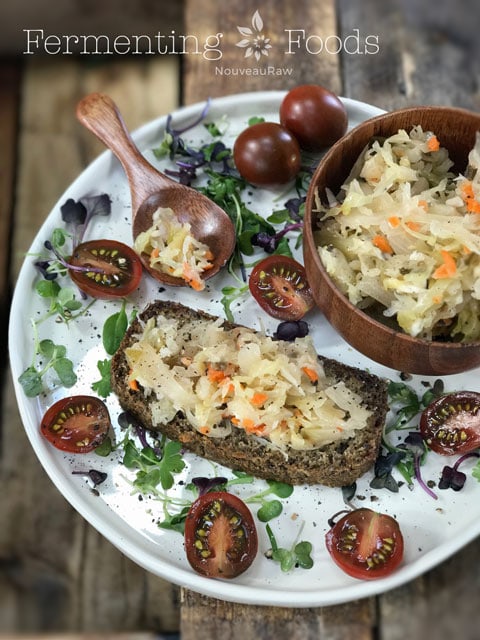 I have to admit when I first heard the phrase “fermented foods”, my nose went up and my ears went back.
Fermentation?
What? Why would I want to eat foods that have gone bad? That was what first entered my mind when I heard that phrase. Now, talk about sauerkraut, I had no problem with that.
As I was growing up nobody ever said, “Hey, want some fermented cabbage on your hot-dog?” It really wasn’t until I started dabbling in raw foods that I become more aware of fermented foods, what they were, and what their benefits are. I encourage you to research this topic further and see if it is something that you might like to try.
What is fermentation:
Fermentation is the process of culturing healthy bacteria in food.
What are the benefits:
Fermented foods contain lactobacillus, most commonly known as Acidophiles which promote good intestinal bacteria populations, they are high in enzymes and are reported to be pre-digested (by bacteria), hence easier for digestion. It also aids in the nutrient assimilation of food.
As an example, cabbage and those in the cabbage family are often known for causing severe flatulence when eaten raw. Once these same vegetables are fermented they don’t have that same effect. Studies have shown that optimal numbers of ‘good’ bacteria increase the immune system’s ability to fight disease. Probiotics may also have a role in reducing the severity of allergies, controlling cravings, and establishing optimal intestinal health.
Is there such a thing as eating too much?
Raw sauerkraut is an extremely healthy food. It is an excellent source of enzymes, vitamin B-complex, Vitamin B-12, vitamin K as well as Vitamin C, therapeutic nutriceuticals, and phytonutrients (higher than Rejuvila & yogurt). The overabundance of lactobacilli and all the dozens of friendly bacteria can easily upset the stomach of people who are not used to eating raw sauerkraut and or raw
food. Hence, introduce the kraut in a small volume, like a tablespoon.
What are some raw fermented foods:
- Sauerkraut
- pickles
- seed “cheese”
- rejuvelac
- sprout milk yogurt
- raw miso
- Kombucha
- raw soy sauce.
Recipes:
- For a great reference book on fermented recipes, please check out Nourishing Traditions by Sally Fallon. Her recipes are very clear and easy to follow.
- Keep in mind that when eating raw fermented foods, the portion size is modest. Enzymes act as catalysts in our digestion and are needed in sufficient quantities. We will receive the enzyme benefit of raw krauts in portions as small as a couple of tablespoons. And, if you are unaccustomed to eating raw sauerkraut, it may be best to eat small for starters, as the acidity/low pH and otherwise healthy, lactic acid bacteria can be unfamiliarity active and stimulating to the digestive.
Ingredients:
Yield: 3 cups (12 servings)
- 1 cabbage, very finely shredded (10 cups)
- Reserved outer leaves of cabbage to cover the cabbage kraut
- 1 tsp salt
Preparation:
- Put the shredded cabbage into a large bowl. Add the salt and gently massage it into the cabbage until the liquid starts to release.
- Let the cabbage rest for 10 minutes and massage it again. Repeat as often as necessary until the cabbage is very juicy.
- Pack the mixture firmly into a large jar, crock, or bowl. Press the cabbage down until the liquid rises above it about an 1/8”. Place the reserved leaves over the top, allowing them to extend partially up the side of the crock; put a small saucer on top.
- If you are using a large jar for your kraut, put a weight on top of the cabbage, such as a small jar, filled with water. If you are using a crock or a bowl, put a plate on top of the cabbage and then a weight. Cover everything with a clean dish towel.
- Allow the kraut to ferment in a cool, dark place for at least 3 days and up to 14 days, depending up the desired degree of sourness.
- Once the kraut is ready, store in sealed jars in the refrigerator for up to several months.



 Add to favorites


Absolutely LOVE your site. User friendly, beautiful pictures, great layout. Have passed this on to many…. Thank you, thank you.
Thank you Kelly…. I appreciate your kindness. I hope you find much inspiration here. Have a wonderful evening, amie sue
Great info! Thank you so much for this awesome site!